A fairness layer for CI that saves money by slowing you down just enough.
TL;DR
CI is too fast, engineers are too parallel, and cloud bills are too real.
The CI Arcade introduces a token-gated queue that meters the blast radius of human enthusiasm. One job at a time. Sometimes.
The Pitch
- Cut CI concurrency without saying “we cut CI concurrency”
- Align engineering behavior with finance targets using playful “game” mechanics
- Make throughput feel like a privilege you earn, not a utility you expect
Core Mechanics
You don’t run CI. You buy a turn.
Token lifecycle
- One active token per user. No token, no CI
- Tokens are consumed on job completion
- Forced issuance lets a user eject their currently running job to get a fresh token. Brutal but fair
Golden path flow
1. User requests token generation.
   - Check for existing active token.
     - If active token exists: Notify user (cannot generate new token).
     - If no active token: Generate new token and mark as active.

2. User requests forced token issuance.
   - Check for active job.
     - If job is running: Terminate job, mark existing token as invalid.
   - Generate new token and mark as active.

3. User provides active token to run CI job.
   - Check token status.
     - If valid: Run CI job, mark token as used upon completion.
     - If invalid: Notify user (token no longer valid).

4. Log CI job result and token used.
   - Provide feedback to user about job outcome.
Sequence diagram
Token state machine
UI Concepts
Interface specifications. Lo-fi prototypes pending design review.
1) Home
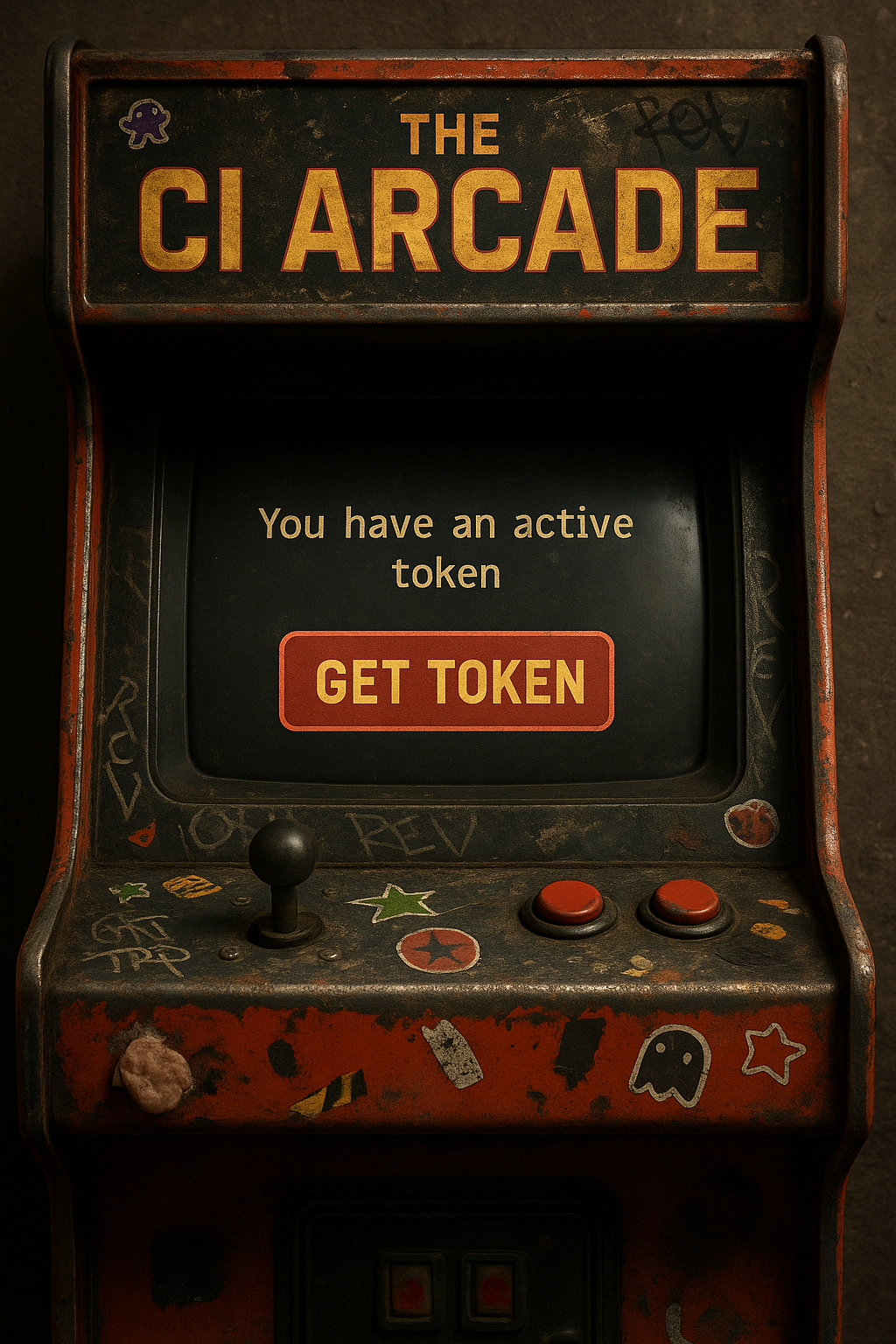
- Big “Get Token” button
- “You have an active token” banner with a sad timer that counts up, not down
2) Queue + Force Issue
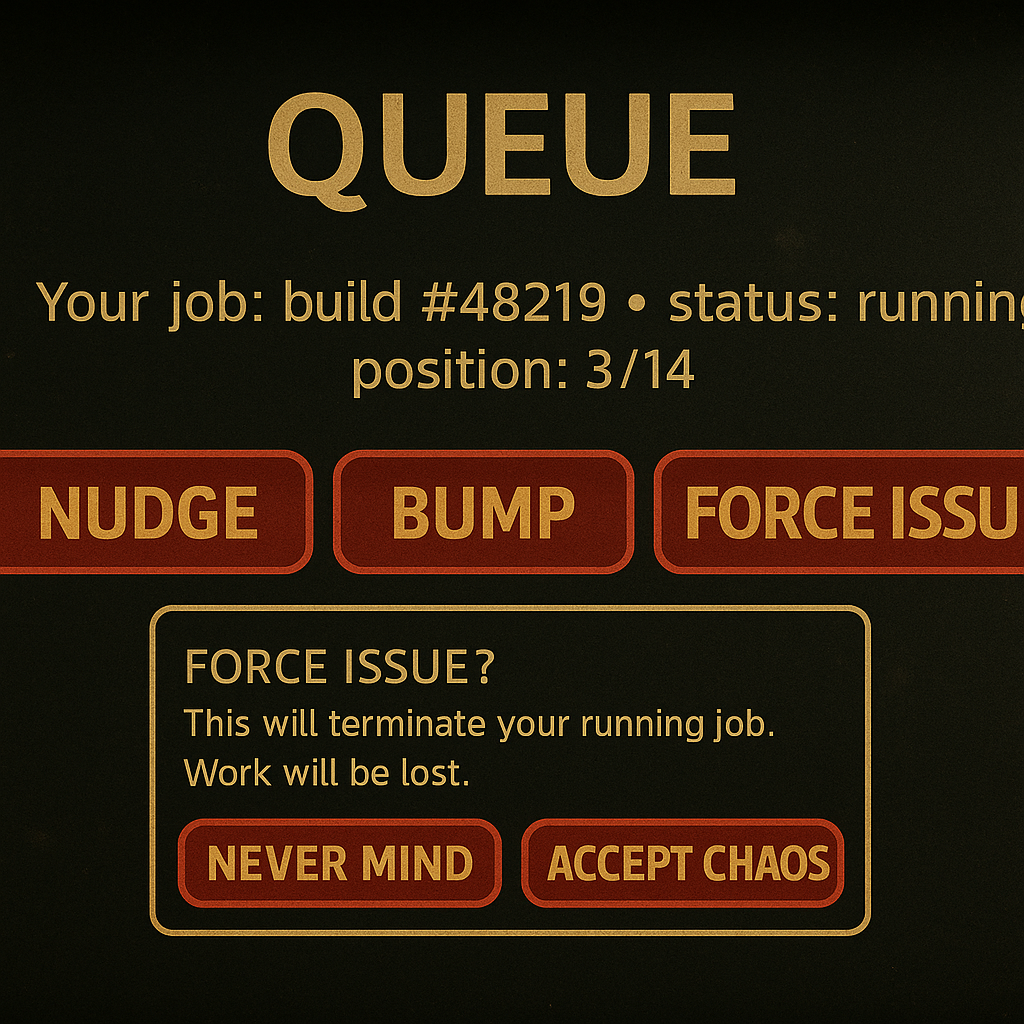
- Status + position in line
- Nudge/Bump controls
- Destructive Force Issue modal with “I accept the chaos”
3) Leaderboards + Finance
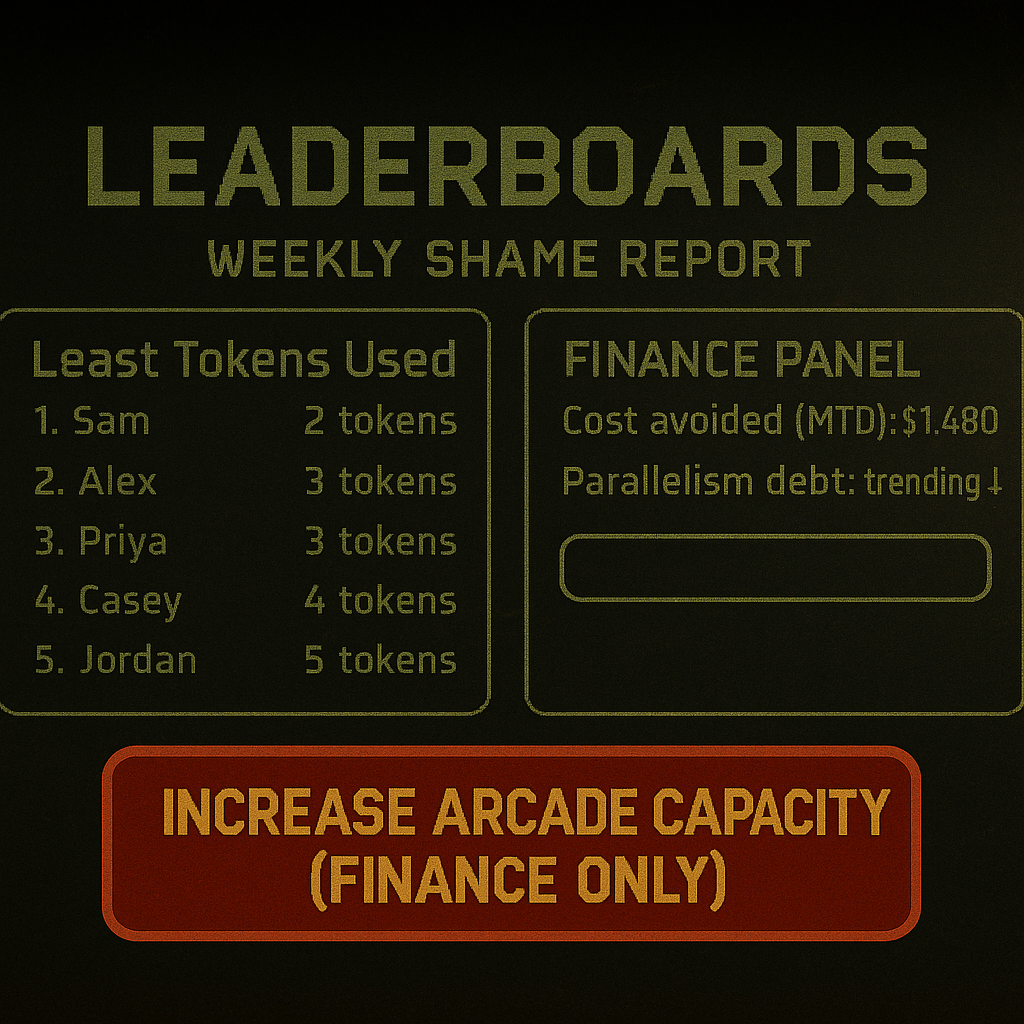
- Least Tokens Used (weekly)
- Finance panel with “Increase Arcade Capacity (Finance only)”
Workflows
“Happy” path
- Developer requests token
- Gets one
- Runs job
- Token is marked used when job completes
Result: Single-flight behavior. Cheap. Calm. Boring. Perfect.
“Panic refactor” path
- Developer spams commits
- Sees “active token exists”
- Tries Force Issue
- Running job is terminated, token invalidated, new token created
- Runs new job
Result: The Arcade discourages thrash with self-inflicted pain. Finance smiles.
“Oops stale token” path
- Developer tries to run a job with an invalid token
- Gets told it’s invalid
- Must request a new token like a normal human
Result: Order restored. Savings continue.
Pricing Theory
Free Soft concurrency caps. Leaderboard participation. Community norms.
Team — $8/seat/month Hard token enforcement. Audit logs. Manager dashboards. Monthly Arcade Health Report (PDF, branded).
Enterprise — Contact Sales
- Dedicated Arcade Success Manager
- Quarterly “Build Intentionality” workshops (CPD credits available in select regions)
- Custom Efficiency Score weighting aligned to your OKRs
- Concierge terminology review: all system strings audited for growth-positive language
- SLA: token issuance P99 < 45 s (intentional — supports deliberate commit practices)
- Joint “Capacity Planning” briefing with Finance, quarterly
SLOs
- Token issuance P50 under 200 ms
- Queue visibility P95 under 1 s
- Job kill-on-force-issue P99 under 3 s
- Monthly target: Arcade Efficiency Score ≥ 0.72 (see Appendix B for scoring model)
Governance and Compliance Theater
- Audit log stores:
- user_id
- token_id
- job_id
- action (issued, validated, consumed, invalidated, killed)
- timestamps
- reason (human text, e.g., “panic push”)
- Retention: 13 months so you can draw bad trend lines during budget season
- “Separation of duties”: only Finance can increase concurrency ceilings
Exemptions
- Staff+ engineers: token limits apply, but Force Issue is pre-authorized
- Incident responders: tokens auto-issued during active PagerDuty P0/P1 alerts
- Release managers during freeze windows: unlimited tokens, Finance-notified post-hoc
Change Management
| RFC | Title | Status | Owner |
|---|---|---|---|
| 000 | Rename “concurrency limit” to “Arcade Capacity” | Approved | Platform |
| 001 | Replace “job cancellation” with “graceful prize reclamation” | Approved | Comms |
| 002 | Happy Hour tokens (2–3 a.m. local) | Rejected — “encourages off-hours heroics” | Eng |
| 003 | Rebrand Force Issue as “Strategic Job Reconsideration” | In Review | Legal |
| 004 | Remove “chaos” from all user-facing strings | Approved | Brand |
Behavioral Design
- Commitment reinforcement: bonus token credits for users who maintain build frequency under 3/day. Encourages deliberate shipping.
- Community recognition: weekly digest highlights top contributors by Arcade Efficiency Score.
- Decision support: pre-confirmation modal on Force Issue surfaces estimated job completion percentage and time remaining. Users make informed choices.
FAQ
Isn’t this just a mutex for humans?
Yes. That’s the point.
Will engineers be slower? No. Engineers will be more intentional. Velocity is a measure of value delivered, not jobs launched. Internal pilots show a measurable reduction in context-switching overhead and a perceived throughput improvement of 12–18%. [n=14, 8 weeks, Platform team]
What about flaky tests?
Great news. You’ll notice them less often because you run fewer jobs.
How do I bypass this?
You don’t. Arcade Capacity is policy, not preference.
Launch Assets
One-pager diagram
Poster copy
- Headline: “Ship less. Save more.”
- Subhead: “Turns, not threads.”
- Footer: “The CI Arcade. One coin per run.”
Slack announcement
Arcade is live. You get one active token. Force Issue kills your job and gives you a new coin. Jobs without valid tokens are bounced. Leaderboards on Friday. Questions in #arcade-support.
How We “Measure Success”
- CI spend down 25–40%
- PRs linger longer but merges still happen
- Engineers report “less chaos” while privately seething
- Finance approves your next pet project because you “found savings”
Appendix: Mindful Builds Workshop Curriculum (90 min)
| # | Module | Duration |
|---|---|---|
| 1 | The Psychology of the Commit | 20 min |
| 2 | Token as Intention: Treating CI Resources as Finite | 25 min |
| 3 | Force Issue and the Ethics of Interruption | 15 min |
| 4 | Building a Personal Arcade Efficiency Practice | 20 min |
| 5 | Closing reflection + goal-setting | 10 min |
Facilitated by a certified Mindful Builds practitioner. CPD credits pending accreditation (expected Q2).